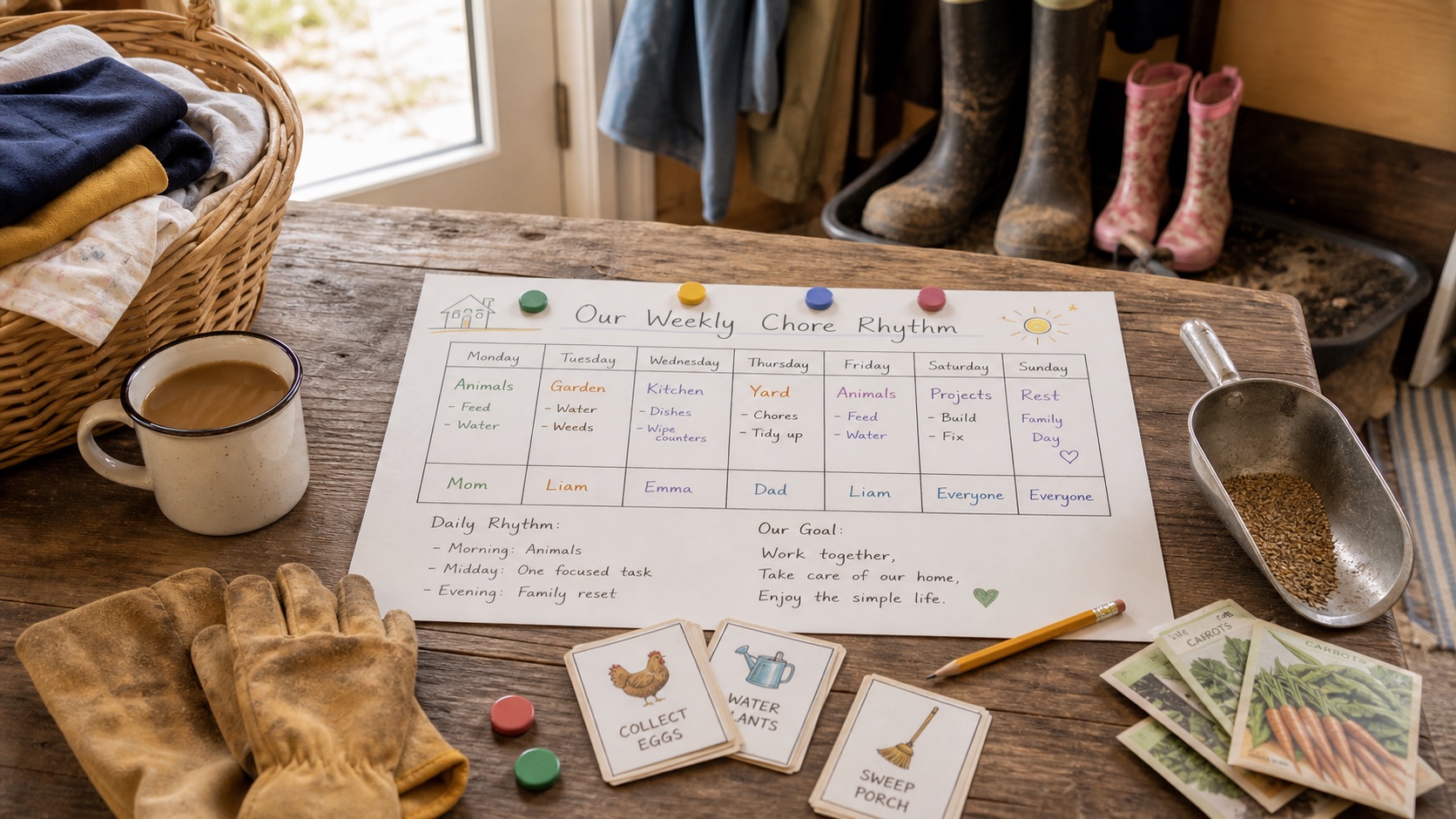
A weekly homestead chore rhythm works best when it is built around anchors that already exist: trash day, grocery day, meal prep, work schedules, school rhythms, and weather windows. Add animals, gardens, cleanup, and projects to real life instead of pretending every day has equal capacity.
A family can be excited about chickens, gardens, preserving, and projects and still have only a few reliable hours each week. The rhythm has to respect tired evenings, uneven weekends, and the fact that children and spouses are not farm employees.
A routine has to work during normal family life. If it only works during a perfect week, it is not a system yet. The goal is not to make the household look more disciplined. The goal is to make the recurring work visible enough that fewer tasks depend on somebody remembering everything.
The real decision underneath this topic
On paper, this guide is about a weekly chore rhythm for families starting homestead life. In practice, the decision is how to assign recurring work without turning family life into a job board. That matters because the first season can add chores faster than the household learns where those chores belong.
A stronger first move is to name the real bottleneck before building the chart. Is the problem forgotten animal care, rushed dinners, loose tools, overloaded Saturdays, unclear kid jobs, or adults carrying invisible work? Each problem needs a different rhythm.
A realistic beginner scenario
Imagine the week is already normal-hard: work or job search, meals, laundry, school or family needs, weather changes, and one outdoor project that keeps asking for attention. The garden needs watering, the feed bin needs checking, the kitchen has to keep functioning, and the weekend cannot become a punishment for everyone.
If the plan only works when the calendar is open and everyone has energy, it is too fragile. The useful version is smaller, more visible, and easier to repeat: daily care stays boring, cleanup has a known home, and projects stop before they consume the whole family weekend.
What I would do first
The important part is not making the first version impressive. The important part is closing the loop. A closed loop teaches you what the next version should be. An open loop mostly creates guilt, clutter, and another decision to carry.
What can probably wait
Most beginners can delay full chore charts for imaginary future animals, tracking every minute, rotating every job before people know the routine, and weekend projects that consume every bit of family margin. Delaying these does not mean giving up on them. It means refusing to spend future energy before the present system has proven it can hold.
Waiting is especially useful when a routine depends on assumptions you have not tested yet. A month of observation can show which chores actually repeat, which ones belong to adults, which ones can be kid-assisted, and which ones were only exciting because the idea was new.
How to tell if the plan is working
A good beginner rhythm leaves evidence. You should be able to see whether mornings are less rushed, whether animal and garden care happen without repeated reminders, whether meals are easier to protect, and whether the weekend has at least one real recovery pocket.
The clearest signal is repetition. If the chore rhythm still makes sense during a busy week, it probably belongs. If it only works when everyone is unusually motivated, it needs to be smaller, more visible, or placed beside a stronger anchor.
The useful next step
The useful rhythm is the one your household can still recognize during an imperfect week.
If you want to turn this into action, write the smallest version on paper today: the daily care list, the household reset, the one project block, the one catch-up window, and the chore that should be removed because the week is already full. That simple written boundary is often what separates a real homestead rhythm from another plan floating around in your head.
The friction audit
A household system should remove friction from a place where the week repeatedly catches. If the system is mainly a prettier way to track failure, it is not ready. Look for the specific snag: mornings start with searching, evenings end with loose tasks, meals depend on memory, outdoor supplies migrate, or projects never fully close. Then design for that snag only.
Systems work best when they are visible at the point of use. A feed note belongs near the feed. A meal plan belongs where food decisions happen. A project list belongs with the calendar, not buried in an app. The more a routine depends on remembering to check the routine, the weaker it is.
Best Next Step
Get the weekly planner before the week scatters again.
The weekly planner helps the advice become a real household pattern instead of another useful page you forget by Thursday.
Get the weekly plannerRecommended next reads
Read the next guide that supports this decision
These are the next pieces most likely to help the bigger picture make more sense without sending you in ten directions at once.
Systems
How to Build a Calmer Weekly Homestead Rhythm
A workable weekly rhythm matters more than bursts of motivation. This is how to structure a steadier, lower-drama home system.

Homesteading
Our First-Year Homestead Priorities: What We’re Doing Now and Why
A first year goes better when priorities are chosen, not inherited. These are the systems and projects we are focusing on now and the reasons behind them.

Homesteading
What I Wish I Knew Before Trying to Build a Simpler Life
A simpler life is not built by adding the right aesthetic. It is built by subtracting noise, choosing better systems, and learning what really matters.
Frequently asked questions
What makes a homestead routine realistic?
A realistic routine is short, visible, and repeatable during normal family life. It should lower decision fatigue instead of becoming another project to manage.
What mistake do beginners make most often here?
Most beginners either overbuild the first version or wait for a perfect future setup instead of starting with one clear, manageable step that teaches them something useful right now.
What should probably wait?
What should usually wait is anything decorative, highly specialized, or dependent on a bigger routine than you have already proven. Reliability first. Complexity later.
Recommendations
Useful tools and resources for this decision
These are included only where they reduce repeated friction, clarify a next step, or help you avoid buying the wrong thing first.
Useful first buy
Field notebook
A simple paper notebook for plans, costs, changed decisions, and recurring tasks.
Best for: Capturing plans, costs, and recurring checklists
Check current priceLearn first before buying
Homestead budget starter sheet
A simple spending framework for prioritizing purchases, borrowing first, and delaying nonessentials.
Read the guideLearn first before buying
Simple habit and planning workbook
A straightforward planning resource for routines, resets, and family rhythms when memory is carrying too much.
Check current priceRecommended next reads
Read next if it helps the decision
Move into the next guide only if it clarifies the next practical step.
Systems
How to Build a Calmer Weekly Homestead Rhythm
A workable weekly rhythm matters more than bursts of motivation. This is how to structure a steadier, lower-drama home system.
Homesteading
Our First-Year Homestead Priorities: What We’re Doing Now and Why
A first year goes better when priorities are chosen, not inherited. These are the systems and projects we are focusing on now and the reasons behind them.
Homesteading
What I Wish I Knew Before Trying to Build a Simpler Life
A simpler life is not built by adding the right aesthetic. It is built by subtracting noise, choosing better systems, and learning what really matters.
Weekly rhythm support
Get the weekly reset planner that keeps the week from scattering.
A print-friendly weekly planner for resets, anchor tasks, and the few routines that make the house feel steadier.
Best for: Readers who need a calmer household rhythm before they need more projects.
- A weekly anchor planner
- A reset checklist
- A what-to-drop, delay, or delegate review
Low-noise notes on routines, resets, and steadier household systems.
After signup, the download will unlock right here so you can save or print it.
About the author
William Mock
Founder, writer, and beginner homesteader
William writes from the beginner side of rebuilding after a layoff: homestead plans, family systems, budgets, tools, and the decisions that make a home feel less fragile.
Read why this site existsRelated Guides
Keep building context
Systems
How to Build a Calmer Weekly Homestead Rhythm
A workable weekly rhythm matters more than bursts of motivation. This is how to structure a steadier, lower-drama home system.
Homesteading
Our First-Year Homestead Priorities: What We’re Doing Now and Why
A first year goes better when priorities are chosen, not inherited. These are the systems and projects we are focusing on now and the reasons behind them.
Homesteading
What I Wish I Knew Before Trying to Build a Simpler Life
A simpler life is not built by adding the right aesthetic. It is built by subtracting noise, choosing better systems, and learning what really matters.